new Renault Clio
On the instrument panel A

Depending on the vehicle, navigate by pressing up/down on switch 1 to select different types of information on the instrument panel, such as driving style indicators.
Gear change indicator 2

Depending on the vehicle, to obtain optimum consumption levels, a warning light on the instrument panel lets you know the best time to move up or down a gear:
 shift up a gear;
 downshift a gear.
If you regularly monitor this indicator you will be able to reduce your vehicle's fuel consumption.
Driving style indicator 3 and 4

"Eco-monitor 3"
"Eco-monitor" is a real-time indicator of your driving style. It can help you to reduce your consumption by providing suitable advice.
The larger the indicator leaf 3, the better the management of speed, acceleration and anticipation in terms of eco-driving.
The smaller the leaf 3, the worse the management of speed, acceleration and anticipation in terms of eco-driving.
If your driving behaviour is deemed uneconomic (small orange leaf), you may be provided with advice.
If you regularly monitor this indicator you will be able to reduce your vehicle's fuel consumption.
"Safety monitor 4"

"Safety monitor" allows you to assess your driving behaviour in real time.
It helps you to ensure your safety by providing you with personalised advice and warnings tailored to your driving.
The shield 4 adapts according to your driving behaviour over the previous few seconds:
- the more full it is, the better your management of speed, safe distance, trajectory and alertness;
- the more reduced it is, the more your driving has points to improve in one or more of these areas.
When it becomes orange and reduced, a tip may appear to help you quickly adjust your driving.
Consult the "Safety monitor" to reduce the risk of accidents, identify your areas for improvement and develop a smooth, serene and responsible driving style.
On the multimedia screen 4
Journey record

When the engine is switched off, a notification appears on the multimedia screen 4 to provide information on your driving during your last trip.
This notification provides direct access to the "ECO driving" menu. This menu provides more information on your driving and its effect on your fuel consumption.
Please refer to the multimedia instructions for further information.
"Free wheel" mode
Depending on the vehicle, for vehicles fitted with an automatic gearbox, in the deceleration phases (with the foot fully off the accelerator pedal), switching to freewheeling (automatic neutral) decreases engine braking and allows you to farther without accelerating in order to save fuel.
The
 warning light appears in grey, then in green to indicate that the vehicle is in "free-wheel" mode.
Note: pressing the brake pedal once deactivates "free-wheel" mode.
tip
When driving downhill, the "free-wheel" function is deactivated in order to use the regenerative braking system and/or the engine brake, depending on the vehicle.
ECO mode
ECO mode is a function which optimises fuel consumption. It affects the vehicle behaviour (acceleration, gear shifting, cruise control, deceleration, etc.).
Limiting acceleration enables low fuel consumption in urban and surrounding areas.
Activating the function
You can access ECO mode:
- from the multimedia screen 4;
- using the steering wheel control 5.

The "ECO" indicator 6 is displayed on the instrument panel to confirm that it is activated.
While driving, it is possible to exit the ECO mode temporarily in order to improve engine performance.
To do this, press the accelerator pedal firmly and fully.
ECO mode is reactivated when you take pressure off the accelerator pedal.
Deactivating the function
Please see the multimedia system user manual for information on how to deactivate ECO mode.
Power meter
(E-tech full hybrid version)
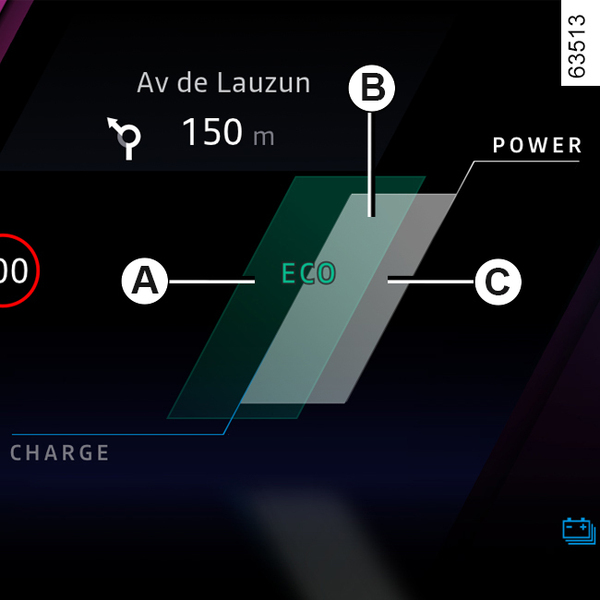
The charge meter gives you a real-time view of the energy consumed or recovered when the vehicle is moving.
"Energy recovery" A usage zone
When driving, if you lift your foot off the accelerator pedal or apply the brake, the motor generates electrical current during deceleration, and this energy is used to slow down the vehicle and recharge the traction battery.
"Optimal" B usage zone
Indicates economical driving, balanced between recovery and energy expenditure.
"Energy consumption" C usage area
In all-electric or hybrid mode, the traction battery and/or the combustion engine supply the energy required to move the vehicle.
Navigation system
Use the information available on your navigation system (traffic information etc.) to simplify your journey.
Driving advice and ECO driving

Heating levels
It is normal to notice an increase in the vehicle's fuel consumption when using the heating (particularly when the outside temperature drops below zero) or air conditioning.
Behaviour
- Drive carefully until the engine reaches its normal operating temperature, rather than let it warm up while the vehicle is stationary.
- High speeds significantly affect the vehicle's fuel consumption.
Examples (at a steady speed):
- reducing the speed from approximately 80 mph (130 km/h) to 68 mph (110 km/h) saves up to around 20% of fuel;
- reducing the speed from approximately 56 mph (90 km/h) to 50 mph (80 km/h) saves up to around 10% of fuel.
- Dynamic driving involving heavy and frequent acceleration and braking is expensive on fuel in comparison to the time saved.
- Do not over rev the engine in the intermediate gears. You should always use the highest gear possible.
- Avoid sudden acceleration.
- Brake as little as possible. If you anticipate an obstacle or bend in advance, you may then simply release the accelerator pedal.
- Do not try to maintain the same speed up a hill, accelerate no more than you would on level ground. Keep your foot in the same position on the accelerator pedal.
- Double declutching and accelerating before switching off the engine are unnecessary in modern vehicles.
- Bad weather, flooded roads:
 Do not drive through water if it is higher than the lower edge of the wheel rim.
warning
Driver obstruction
On the driver's side, only use mats suitable for the vehicle, attached with the pre-fitted components, and check the fitting regularly.
Do not lay one mat on top of another.
There is a risk of wedging the pedals.

Tyres
- An underinflated tyre increases fuel consumption.
- To optimise fuel consumption, set the highest speed tyre pressure or the recommended pressure indicated on the edge of the driver's door Tyre pressure.
- The use of non-recommended tyres can increase fuel consumption.

Advice on use
- Favour the ECO mode.
- Electricity is fuel – switch off all the electrical components when they are not genuinely needed. However (safety first), keep your lights on when the visibility is bad ("see and be seen").
- Use the air vents. Driving with the windows open at 62 mph (100 km/h) will increase fuel consumption by 4%.
- Never fill the fuel tank right to the brim to avoid overflow.
- On vehicles equipped with non-automatic air conditioning, switch off the air conditioning when it is not required.
Advice for reducing consumption and helping to preserve the environment:
If the vehicle has been parked in the sun, open the doors for a few moments to let the hot air escape before starting the engine.
- Do not leave an empty roof rack fitted to the vehicle.
- It is better to fit a trailer for bulky objects.
- When towing a caravan, fit a wind deflector and adjust it carefully.
- Avoid using the vehicle for "door-to-door" calls (short journeys with long waits in between) because in such conditions the engine never reaches its optimal operating temperature.