Renault Symbioz
Based on information from a radar or camera, the adaptive cruise control function (or the Stop and Go adaptive cruise control function on vehicles equipped with an automatic gearbox)enables you to maintain the speed selected, known as the cruising speed, while keeping a following distance with the vehicle in front in the same lane.
Depending on the vehicle, when the "Road Sign Detection" function is activated Detection of road signs, the system can adapt the speed of your vehicle according to the speed limit signs recognized by the camera.
Depending on the country and subscription, the system will use the camera and the map to adjust the vehicle speed in advance according to the context and road incidents (roundabouts, bends, upcoming road signs or speed limit zones).
On vehicles fitted with an automatic gearbox, if the vehicle in front stops, the Stop and Go adaptive cruise control function may brake your vehicle to a complete stop before allowing the vehicle to move on again.
The system controls acceleration and deceleration of your vehicle using the engine and braking system.
The system's maximum range is approximately 130 metres. This may vary according to the road conditions (ground relief, weather conditions, etc.)
According to road conditions (traffic, weather, etc.), the "Adaptive cruise control" function can be activated:
- from 0 mph (0 km/h) for vehicles fitted with an automatic gearbox;
- from 12 mph (20 km/h) for vehicles fitted with a manual gearbox.
The function is indicated by the
 symbol.
Note:
- the driver must observe the maximum speed limit and safe distances according to the legislation in the country where they are driving;
- the adaptive cruise control can brake the vehicle up to a third of the braking capacity. Depending on the situation, the driver may need to brake harder.
tip
The adaptive cruise control does not trigger an emergency stop and its braking capability is limited.
warning
This function is an additional driving aid.
It can under no circumstances replace the driver's responsibility to respect speed limits and safe distances or to be vigilant.
The driver must always be in control of the vehicle.
The driver must always adapt their speed according to the surroundings and traffic conditions.
Use the adaptive cruise control outside built-up areas, on wide roads with visible lines.
The cruise control may have limited operation on very winding or slippery roads (black ice, aquaplaning, gravel) or during bad weather (fog, rain, side winds, etc.)
There is a risk of accidents.
Location of the camera and radar
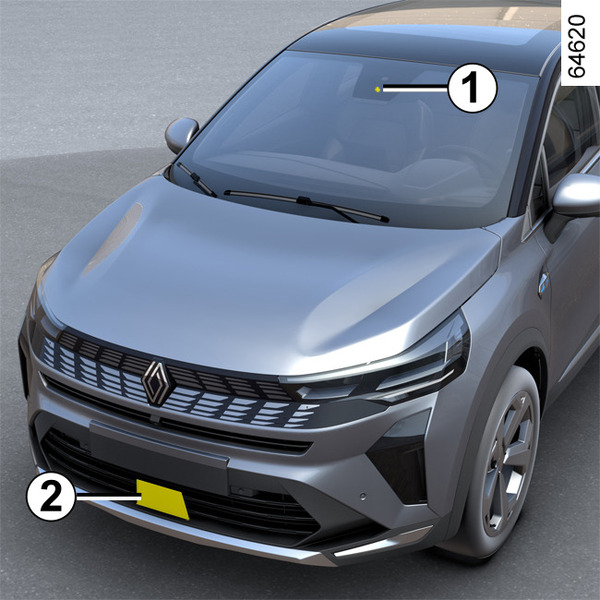
Camera 1
Make sure the windscreen is not obscured (by dirt, mud, snow, condensation etc.).
Radar 2
Ensure that the radar area is not obstructed (dirt, mud, snow, a badly fitted/attached front number plate), impacted, modified (including paintwork) or hidden by any accessory fitted on the front of the vehicle (on the grille or logo etc.).
warning
The radar and camera zones must be kept clean and free of any tampering in order to ensure the proper operation of the system.
Controls

- 3.
Switch for selecting/deselecting the driving aids, depending on the vehicle:
- the Active driver assist;
- Adaptive Cruise Control;
- cruise control;
- speed limiter;
- OFF.
- 4.
Safe distance settings
- 5.
- Recall the stored cruising speed (RES).
- 6.
Activates, stores or reduces the cruising speed or stores the current speed (SET/-).
- 7.
Switch to activate and increase cruising speed or to recall the memorised cruising speed (SET/+).
- 8.
Puts the function on standby and stores the limited speed (0).
- 9.
Pop-up button (depending on the vehicle): adapt the speed setpoint to detected speed limits
 Detection of road signs.
tip
Depending on the vehicle, you can link the adaptive cruise control function to the "Road sign detection" function Detection of road signs by pressing the switch 7.
Depending on the vehicle, if "OFF" mode is selected before switching off the engine, the "Speed Limiter" function will be activated by default the next time the vehicle is started.
Displays

- 10.
Adaptive cruise control warning light.
- 11.
Vehicle in front.
- 12.
Stored safe distance
- 13.
Stored cruising speed.
warning
Important: you should keep your feet near the pedals at all times to prepare for any event.
Switching on
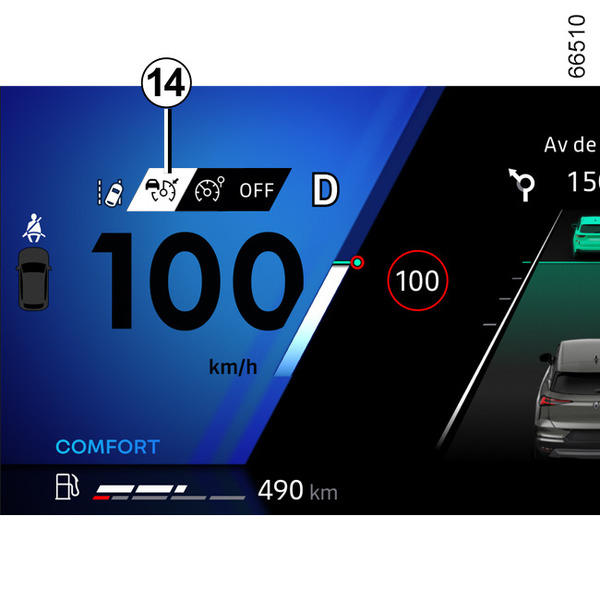
Press switch 3 to select the adaptive cruise control 14.
The warning light 10
appears in grey and the "Adaptive cruise control ready: SET to activate" message appears on the instrument panel accompanied by dashes to indicate that the function is activated and waiting to store a cruising speed.
This function cannot be activated when:
- the parking brake is applied;
- the driver's seat belt is not fastened;
- one or more doors are incorrectly closed;
- the "Hands-free parking" function is already activated.
The "Adaptive Cruise Ctl unavailable" message is displayed on the instrument panel.
Activating cruise control
When the vehicle is stationary or moving at a steady speed, press switch 7 (SET/+) or switch 6 (SET/-) to activate the function and store the current speed.
The minimum cruising speed that can be selected is;
- 19 mph (30 km/h) for vehicles fitted with a manual gearbox;
- 12 mph (20 km/h) for vehicles equipped with an automatic gearbox.
The cruising speed 13 replaces the dashes and the cruise control function activation is confirmed by the appearance of the cruising speed in green and the warning light 10
.
If you try to activate the function when the vehicle speed is over 112 mph (180 km/h) or below 12 mph (20 km/h) on vehicles fitted with a manual gearbox, the "Invalid Speed" message is displayed and the function will remain inactive.
Once a cruising speed is memorised and the cruise control function is active, you may lift your foot off the accelerator pedal.
Note: if your vehicle's speed is less than:
- 19 mph (30 km/h) on vehicles equipped with a manual gearbox, the cruising speed taken into account by the function is 19 mph (30 km/h) by default;
- 12 mph (20 km/h) on vehicles equipped with an automatic gearbox, the cruising speed taken into account by the function is 12 mph (20 km/h) by default;
Activating cruise control with speed limit sign recognition (display A)


(depending on the vehicle)
If the vehicle is equipped with the "Road Sign Detection" Detection of road signsfunction, press the contextual button 9 to adapt the vehicle's speed to the 15 speed limits detected by the camera.
When passing the sign, the cruising speed 13 adopts the value of the detected speed 15.
Automatic activation of cruise control with advance speed limit sign recognition (display B)


Using the camera, the "Road sign detection" function Detection of road signs and the map associated with the subscription, the system anticipates the automatic adjustment of the vehicle speed until the next sign is identified 16.
Activation/deactivation
From the multimedia screen, in the "Vehicle" World, select "Driving assistance". Then, from the "Comfort" menu, select "Speed limit adaptive cruise control".
You can also activate/deactivate the function by pressing and holding the pop-up button 9.
The letter "A" 17 is displayed on the instrument panel to confirm the activation of the cruise control with advance speed limit sign recognition.

Note: in the event of a discrepancy between the vehicle speed and the speed limit 14, the driver may be asked to manually validate the speed by pressing the pop-up button 9. The white square 18 is displayed around the indicated speed to inform you.
tip
Cruise control with advance speed limit sign recognition is associated with a subscription. If there is no subscription, this function cannot be activated.
To manage the subscription, please refer to the multimedia instructions.
Operation
With the function activated, the following speeds are displayed on the instrument panel:
- cruising speed 13;
- the current speed limit 15 detected by the system on the section of road on which the vehicle is moving;
- the speed 16 detected by the system on the next road section or speed limit zone.
The detected speed 16 is taken into account by the system. The vehicle speed adjusts gradually, until it becomes the cruising speed 13, without any action from the driver. The speed indicated on 16 is displayed on 15 when passing the sign or zone identified.
The driver must always stay vigilant regarding the speed applied by the system and remains responsible for the vehicle speed.
When the function is not activated or the subscription is no longer active, the operation is identical to setting the cruising speed with speed limit sign recognition (display A).
Automatic activation of cruise control with advance recognition of the road layout (display C)

Using the camera, the "Road sign detection" function Detection of road signs and the maps purchased with the subscription, the system can anticipate and manage the automatic adaptation of your vehicle's speed when it detects certain conditions (such a roundabout, bend, etc.).
Activation/deactivation
From the multimedia screen, in the "Vehicle" World, select "Driving assistance". Then, from the "Comfort" tab, select "Road layout adaptive cruise control".
Operation
When a condition is detected, a symbol 19 is displayed on the instrument panel to inform you. The vehicle then automatically adjusts its speed to approach the detected area.
Once the condition is no longer present, the vehicle resumes the cruising speed 13.
The driver must always stay vigilant regarding the speed applied by the system and remains responsible for the vehicle speed.
When the function is not activated or the subscription is no longer active, operation is the same as setting the cruising speed with speed limit sign recognition (display A or, depending on the subscription, setting the cruising speed with advanced speed limit sign recognition (display B).
The following symbols indicate the driving situations that the system takes into account:
-
 (roundabout);
 -
 (bend).
 -
 speed limit;
When the direction indicator light is activated:
-
 (depending on geographical area, exit).
Note:
- in cruise control mode with speed limit sign recognition (display A), if the driver does not manually validate the new speed limit suggested in the white square, once the driving situation has passed, the vehicle will automatically return to the initial cruising speed;
- only the events mentioned are taken into account. Other events are not taken into account (stopping or giving way, slopes, tolls, etc.).
tip
Cruise control with advance recognition of the road layout is associated with a subscription.
If there is no subscription, this function cannot be activated.
To manage the subscription, please refer to the multimedia instructions.
Controlling cruising speed
You can resume control of the vehicle speed at any time by:
- putting the function on standby:
- by pressing the brake pedal;
- or by pressing the switch 8 (0);
- by pressing the driving aids selection/deselection switch 3.
Predictive Event and Traffic Alerts
(depending on the vehicle)
Using real-time traffic information, the system can warn you of traffic hazards detected along your route. A warning light appears on the instrument panel, accompanied by a message.
Please refer to the multimedia instructions for further information.
Activation/deactivation
From the multimedia screen, in the "Vehicle" World, select "Driving assistance". Then, from the "Comfort" menu, select "Predictive Event and Traffic Alerts".
Operation
Depending on the subscription and/or geographical area, the vehicle will take into account the following dynamic event and, if necessary, will automatically adapt its speed:
-
 (heavy traffic).
Note: if there is a low level of confidence in the detection of the event, the system will simply warn the driver with a "Heavy traffic" message.
Depending on the subscription and/or geographical area, the user is warned of the presence of the following events, but the cruising speed will not be impacted:
-
 (roadworks);
 -
 (accident);
 -
 (stationary vehicle).
Note: heavy traffic, roadworks, accidents and stationary vehicles are dynamic events whose position may be less precise.
The driver must always stay vigilant regarding the speed applied by the system and remains responsible for the vehicle speed.
Setting the cruising speed
You can vary the speed by pressing repeatedly (for low variation) or pressing and holding (for high variation):
- the "SET/-" switch 6 to reduce the speed;
- the "SET/+" switch 7 to increase the speed.
Safe distance control activation
As soon as cruise control is activated, the default safe distance 12 is displayed in green on the instrument panel. The default following distance corresponds to approximately 2 seconds.
If the system detects a vehicle in your lane, an outline of a vehicle 11 appears above the distance gauge 12 on the instrument panel.
Your vehicle adapts its speed to that of the vehicle in front and applies the brakes if necessary (the brake lights come on) in order to maintain the distance displayed on the instrument panel.
Note: the size of the 11 outline varies according to the distance separating you from the vehicle in front. The larger the outline, the closer the vehicle in front.
Adjusting the following distance

You can vary the safe distance from the vehicle in front at any time by pressing switch 4 repeatedly.
The horizontal distance gauge on the instrument panel indicates the various available safe distances:
- distance gauge D: long distance (corresponding to approximately 2.4 seconds);
- distance gauge E: intermediate distance 2 (corresponding to approximately two seconds);
- distance gauge F: intermediate distance 1 (corresponding to approximately 1.6 seconds);
- distance gauge G: short distance (corresponding to approximately 1.2 seconds).
The selected distance gauge appears in green on the instrument panel. The other gauges remain in grey.
Note: the distance must be set according to the traffic level, local regulation and weather conditions.
tip
The safe distance is adjusted by default on the distance gauge E.
Exceeding the cruising speed
The cruising speed may be exceeded at any time by applying the accelerator pedal.
During overtaking, the cruising speed 13 is displayed in yellow: the "Distance Control" function is no longer ensured.
Then, release the accelerator pedal: the cruise control and safe distance control will automatically resume the speed and distance instructions that you had previously selected.
Overtaking manoeuvre
If you want to overtake the vehicle in front and your speed is over 43 mph (70 km/h) only, activating the direction indicators temporarily reduces the following distance and triggers acceleration to facilitate overtaking.
Anticipation of braking in the event of a lane change using the direction indicator
On vehicles equipped with an automatic gearbox, if you want to move to an adjacent lane where a slower vehicle is already present: when you activate the direction indicator, the system will start to adjust your speed to the speed of that vehicle before starting the lane changing manoeuvre.
Prevention of unauthorised overtaking
On vehicles equipped with an automatic gearbox, when your vehicle's speed is above approximately 37 mph (60 km/h), the system can prevent unauthorised overtaking on the right-hand side (or on the left-hand side, depending on local regulations) if you approach a vehicle that is in the adjacent lane.
In this case, the system automatically adjusts your speed to prevent overtaking.
However, you can temporarily deactivate this function by pressing the accelerator pedal lightly in order to resume the cruising speed.
Note: the system adapts to the local regulations in the country where you are (driving on the right-hand side or left-hand side).
Stopping the vehicle and setting off
On vehicles fitted with an automatic gearbox, if the vehicle in front slows down, the system adapts its speed to a complete stop if necessary (in the event of a traffic jam, etc.). The vehicle stops a few metres from the vehicle in front. The Stop and Start function can put the engine on standby Stop and Start function.
When the vehicle in front sets off again:
- if the stop lasts for less than thirty seconds, the vehicle will start again without any action required from the driver.
Note: the driver should always be ready for sudden incidents while driving and remains responsible for controlling the vehicle: if the system detects a pedestrian in the area around the vehicle, the automatic restart will be inhibited until the next stop;
If the stop exceeds approximately thirty seconds, you must press the accelerator pedal or press button 5 (RES) in order for the vehicle to set off again.
The message "Press RES or accelerate to restart Cruise Control" appears on the instrument panel to confirm.
If the stop exceeds around three minutes, the electronic parking brake is automatically applied and the adaptive cruise control is deactivated.
The
warning light 10 disappears to confirm that the function is deactivated.
Putting the function on standby
You can set the function to standby when:
- you press switch 8 (0);
- you apply the brake pedal while the vehicle is moving.
The function is deactivated by the system if:
- you set the automatic gearbox to P or N;
- you engage the reverse gear;
- you unbuckle the driver's seat belt;
- you open one of the opening elements;
- you press the engine start/stop button;
- the slope is too steep;
- the vehicle speed is above 112 mph (180 km/h);
- when you press the clutch pedal for a prolonged period or upon prolonged neutral position on vehicles equipped with a manual gearbox;
- certain driving aids and correction devices are triggered (active emergency braking, ABS, ESC).
Note: Depending on the vehicle, if the reception of the connected data is not optimal, the system automatically switches on standby the advance speed limit sign recognition and/or advance recognition of the road layout functions.
The two functions are automatically reactivated as soon as reception of the connected data becomes optimal again.
In all circumstances, the standby status is confirmed when the warning lights appear in grey and the "Adaptative cruise control disconnected" message appears on the instrument panel.
warning
Putting the adaptive cruise control on standby or switching it off does not cause a rapid reduction in speed: you must brake by pressing the brake pedal if necessary.
Exit from standby
Based on the stored cruising speed
If a speed is stored, it can be recalled, once you are sure that the road conditions are suitable (traffic, road surface, weather conditions, etc.).
Press switch 5 (RES) or switch 7 (SET/+) within the range of valid speeds.
When the stored speed is recalled, activation of the cruise control is confirmed by the illumination of the cruising speed in green.
Note: if the stored speed is higher than the current speed, the vehicle will accelerate to reach that speed.
Based on the current speed
When the cruise control is set to standby, pressing switch 6 (SET/-) reactivates the cruise control function without taking into account the stored speed: it is the speed at which the vehicle is moving that is taken into account.
"Take control of the vehicle" warnings

In some situations (e.g. coming upon a much slower vehicle, vehicle in front changing lanes quickly, etc.) the system may not have time to react.
Depending on the situation, the system sounds a beep associated with:
- the orange alert H if the situation requires the driver's attention;
or
- the red alert J accompanied by the "Brake" message if the situation requires immediate action by the driver.
In all situations, react accordingly and perform the appropriate manoeuvres.
Switching off the function
The "Adaptive cruise control" function is interrupted when you press switch 3.
The warning light
disappears from the instrument panel to confirm that the function is no longer active.
tip
To exit the driving assistance, press switch 3 as many times as necessary until OFF. The message "Driving Assistance deactivated" appears on the instrument panel.
In this case, depending on the vehicle, the next time the engine is started, the "Speed Limiter" function will be activated and waiting for a speed limit to be stored.
Temporary unavailability
Radar
The radar is able to detect vehicles in front of your vehicle. The system cannot operate correctly if the radar detection area is obscured or if its signal is disrupted.
If the radar detection area is obstructed or the radar signal is disrupted, the "Front radar no visibility" message is displayed on the instrument panel and the adaptive cruise control function is interrupted.
The green warning light 10 disappears to confirm that the function has been automatically deactivated.
Ensure that the radar area remains clean and is not obstructed by snow, mud, a badly fitted number plate or by any accessory fitted on the front of the vehicle (on the grille), or hidden by any accessory fitted on the front of the vehicle (on the grille or logo, etc.).
Conditions in certain geographical areas may hinder the function, for example:
- arid zones, tunnels, long bridges or lightly used roads without road lines, without signs or trees nearby;
- a military or airport zone.
You must leave such areas in order for the function to work.
In all cases, if the message is not erased after the engine is restarted, please contact an authorised dealer.
Camera
The system cannot operate if the camera is obscured (by dirt, mud, snow, condensation, etc.).
In the event of decreased visibility of the camera, the performance of the adaptive cruise control will be reduced. Remain vigilant.
Operating faults
If an adaptive cruise control function operating fault is detected, the "Check adaptive cruise control" message appears on the instrument panel and the adaptive cruise control function is suspended.
If an operating fault is detected on one or more components of the system, the adaptive cruise control function is interrupted.
Depending on the type of malfunction, a message is displayed on the instrument panel accompanied, depending on the vehicle, by the
 warning light:
- « Check Front camera » ;
- « Front radar to check » ;
- « Check Camera/Radar » ;
- « Check vehicle » ;
- « Driving assist unavailable » ;
- « Front camera no visibility » ;
- « Front radar no visibility » ;
Consult an approved Dealer.
Limitations of system operation
Vehicle detection
The system detects only vehicles (cars, trucks, motorbikes) that are moving in the same direction as your vehicle.
The system may trigger abrupt or delayed braking.

The system cannot detect:
- vehicles arriving at intersections: slip road (example L);
- vehicles driving on the wrong side of the road or reversing towards you.
tip
The adaptive cruise control must be used outside built-up areas, on wide roads with visible lines.
Detection during cornering

When entering a corner or bend, the radar and/or camera may be temporarily unable to detect the vehicle in front (e.g. M).
The system may trigger an acceleration.
When exiting a bend, the system's detection of the vehicle in front may be disrupted or delayed.
The system may trigger abrupt or delayed braking.
Detection of vehicles in adjacent lanes

The system may detect vehicles driving on an adjacent lane when:
- you drive into a bend (example N);
- you are driving on a road with narrow lanes;
- the speed of the vehicle on the adjacent lane is slower and if one of these vehicles is located too close to the lane of the other.
The system may incorrectly trigger vehicle slowing or braking.
Vehicles hidden due to variations in ground relief
The system will not detect vehicles hidden due to variations in ground relief or those located outside of the camera and radar detection areas when driving uphill or downhill.
Vehicles outside the camera and radar detection areas.


The system will react late or not at all if the detected vehicles are outside the camera and radar detection areas, particularly in the following cases:
- vehicles transporting long objects which exceed the line;
- the actual length of tall vehicles (e.g. P) is outside the radar detection area (construction machine, agricultural equipment towing vehicle, etc.);
- vehicles insufficiently centred in the lane;
- narrow vehicles which are very close (e.g. Q).
Stationary and slow moving vehicles
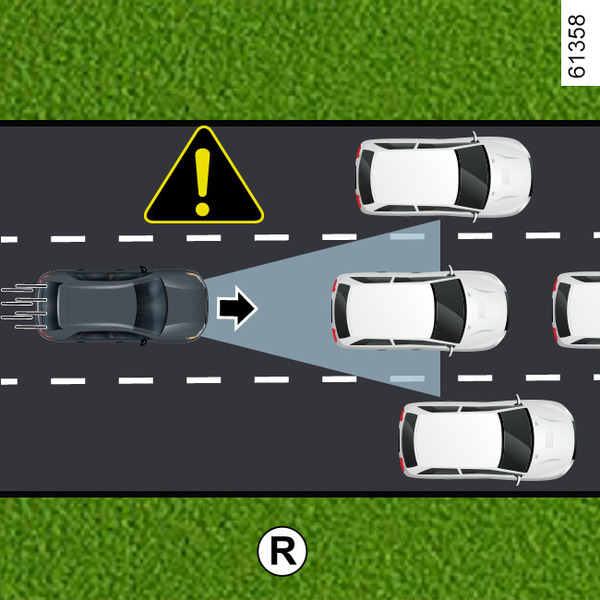
When your speed is over approximately 31 mph (50 km/h), the system does not detect:
- stationary vehicles (e.g. R);
- very slow moving vehicles.
When your speed is less than approximately 31 mph (50 km/h), the system may not react or may react very late to:
- stationary vehicles (e.g. R);
- very slow moving vehicles;


- Vehicles in front 20 that change lane, revealing a stationary vehicle 21 (example S).
tip
Always be ready to respond in all circumstances.
The driver must always be in control of the vehicle.
The adaptive cruise control does not trigger an emergency stop and its braking capability is limited.
Warning
warning
This function is an additional driving aid. It can under no circumstances replace the driver's responsibility to respect speed limits and safe distances or to be vigilant.
The driver must always be in control of the vehicle.
The driver must always adapt their speed to the surroundings and driving conditions, regardless of system indications. Except for lines delimiting lanes, traffic indicators (traffic lights, signs, pedestrian crossings etc.) are not recognised by the system. These do not trigger any alert or reaction by the system.
The system should under no circumstances be taken to be an obstacle detector or an anti-collision system.
The adaptive cruise control must only be used on a motorway (or multi-lane road separated by a barrier).
System servicing/repairs
- In the event of an impact, the radar and/or camera alignment may be changed and its operation may consequently be affected. Deactivate the system and consult an authorised dealer.
- Any work in the proximity of the radar and/or camera (replacements, repairs, windscreen modifications, paintwork etc.) must be carried out by a qualified professional.
Only an authorised dealer is qualified to service the system.
warning
Deactivating the function
You must deactivate the function if:
- the vehicle is travelling on a winding road;
- the vehicle is being towed (breakdowns);
- the vehicle is towing a trailer or a caravan;
- the vehicle is being driven in a tunnel or close to a metallic structure;
- the vehicle arrives at a toll point, a roadwork area or on a narrow lane;
- the vehicle is being driven up or down a very steep slope;
- the visibility is poor (glaring sun, fog, etc.);
- the vehicle is being driven on a slippery road surface (rain, snow, gravel, etc.);
- the weather conditions are poor (rain, snow, side winds, etc.);
- the radar area has been damaged (impacts, etc.);
- the camera area has been damaged (e.g. on the inside or outside of the windscreen);
- the windscreen is cracked or distorted.
In the event of the system behaving abnormally, deactivate it and consult an authorised dealer.
warning
In the event of system disturbance
Some conditions can disturb or damage the system's operation, such as:
- the windscreen or the radar area is obscured (by dirt, ice, snow, condensation, number plate, etc.);
- a complex environment (tunnel, etc.);
- poor weather conditions (snow, heavy rain, hail, black ice, etc.);
- poor visibility (night, fog, etc.);
- poor contrast between the vehicle preceding it and the surrounding area (e.g. white vehicle in a snowy area, etc.);
- being dazzled (glaring sun, lights of vehicles travelling in the opposite direction; etc.);
- narrow, winding or undulating road (tight bends, etc.);
- a slower vehicle with a significant difference in speed;
- use of mats not adapted to the vehicle. On the driver's side, only use mats suitable for the vehicle, attached with the pre-fitted components, and check the fitting regularly. Do not lay one mat on top of another. There is a risk of wedging the pedals.
In these cases, the system may wrongly intervene.
Risk of unwanted braking or acceleration.
Many unforeseen situations may affect the system operation. Certain objects or vehicles that can appear in the camera or radar detection zone may be interpreted by the system incorrectly, possibly leading to inappropriate acceleration or braking.
You should always be attentive to sudden events that might occur while you are driving. Always keep your vehicle under control by keeping your feet near the pedals, so that you are ready to act in any event.