Renault Kangoo E-Tech electric
When releasing the accelerator pedal, the vehicle uses regenerative braking to slow down.
Some of this energy is converted to electricity to recharge the traction battery.
D/B mode or the paddles behind the steering wheel can be used to increase or decrease regenerative braking.
warning
The regenerative braking should under no circumstances be used as a substitute for the brake pedal.
tip
If driving in a mountainous area or under certain conditions (full traction battery, hot engine, etc.), the regenerative braking system may become unavailable.
In this case, when you lift your foot off the accelerator pedal, the "engine" brake becomes gradually unavailable (within a few seconds) to alert the driver.
Full braking capability can be maintained by pressing the brake pedal to limit the vehicle's speed.
Regenerative braking change paddles 1 and 2
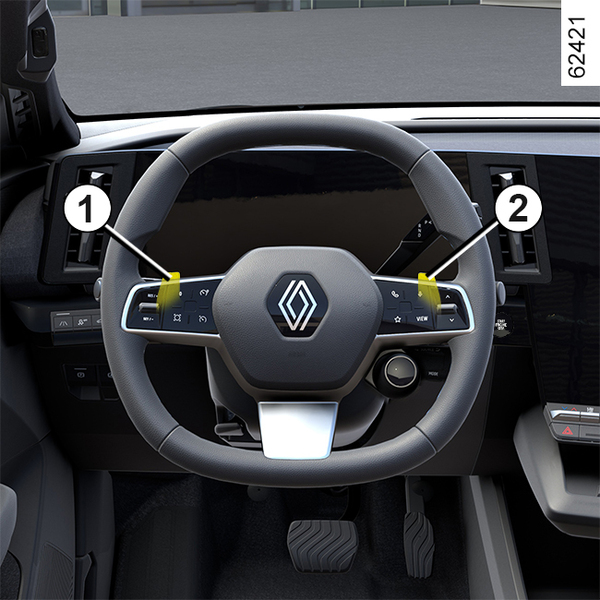
Depending on the vehicle, paddles 1 and 2 can be used to change the regenerative braking level when the gear lever is in D position:
- pull paddle 1 to increase the regenerative braking level;
- pull paddle 2 to decrease the regenerative braking level.
The paddles can only be operated when the gear lever is in D position. It is not possible to use the paddles while the adaptive cruise control Stop and Go is activated Stop and Go adaptive cruise control.
Driving with paddles


Regenerative braking levels
The indicator light 3 informs you of the regenerative braking level:
- A: "Free-wheel" level for gentle, economical driving. Requires driving with anticipation;
- B: low regenerative braking level;
- C: medium regenerative braking level;
- D: strong regenerative braking level;