Renault Master 3 phase 1
Please ensure that you comply with the legislation of your country. It is important to remember that failure to respect regulations in force could lead to legal action being taken against the vehicle owner.
Operating principle
The reagent is intended for diesel engines fitted with the SCR (selective catalytic reduction) system. Using the reagent reduces the quantity of nitrogen oxides in exhaust gases.
Reagent quality
Use only reagents which conform to standard ISO 22241 and in accordance with the mark on the tank filler cap.
Average fuel consumption
Approximately 0.77 gal/620 miles (3.5 l/1000 km), depending on the vehicle.
Consumption in real time depends on vehicle usage conditions, the equipment fitted and the user’s driving style.

Topping up
Capacity of the fuel tank: 4.4 gal (20 litres) approximately.
Open the front passenger door to open the cover 2. Unscrew the cap 1.
Note: Ammonium hydroxide vapour may escape from the cap opening when the tank temperature is high.
Vehicle fitted with the Stop and Start function
To fill up with reagent, the engine must be stopped (and not on standby): stop the engine (please see “Starting, stopping the engine” in Section 2).
If the “XXX KM STOP ADD ADBLUE” message appears, fill the reagent tank and refer to the filling instructions.
Risk of immobilisation of the vehicle.
Fuel filler cap: this is specific.
If you have to replace it, make sure it is identical to the original cap. Contact an approved Dealer. Do not wash the filler area with a high pressure washer.
Precautions for use
The tank can be filled at the pump. In other cases, it is essential to read the information shown on the reagent container (e.g. the can or bottle).
When filling, handle the reagent carefully. They can damage clothes, shoes, bodywork components etc.
If the reagent overflows, or contaminates any paintwork, clean the affected area quickly with plenty of cold water and a soft cloth.
Note: If the reagent crystallises, use a soft sponge.
The reagent must not come into contact with eyes or skin. If it does, wash the affected area with plenty of cold water. If necessary, consult a doctor.
In extreme cold weather conditions
In frosty weather conditions, the reagent tank should be refilled when the indicator and the message “Top Up AdBlue before 1500 km” appear on the instrument panel.
Special cases
The reagent fluid freezes below about -10°C.
In these conditions, do not attempt filling when the fluid is frozen. In the event of needing to top up or fill the tank with reagent ( on), park the vehicle in a hotter location if possible so that the reagent becomes liquid again. Otherwise, have a qualified professional top up or fill up with reagent fluid.
After filling the reagent tank, check that the cap and cover are closed, start the engine and WAIT 10 seconds with the vehicle stationary, engine running, before setting off again.
If this operation is not carried out, the filling of the tank will not be taken into account automatically until after several dozens of minutes of driving.
The message “--- ADD ADBLUE” and/or the warning lights will continue to appear until the filling has been registered by the system.
No work whatsoever is permitted on any part of the system. To prevent damage, only qualified personnel from our network may work on the system.

Alert with message on the instrument panel on display 3
Front-wheel drive and van versions
Warning lights and the messages on the instrument panel 3 are displayed according to the estimated range of the remaining reagent.
Depending on how the vehicle is driven, they may be displayed before the reagent gauge on the instrument panel is at minimum (refer to the information on “Displays and indicators” in section 1).
Maintenance/Range The information displayed on the instrument panel may be accompanied by a beep. | ||
Indicator lights | Messages | What to do? |
- | “ADBLUE LEVEL CORRECT” | - |
- | “Top Up AdBlue before 2400 km” | If the message is displayed when the ignition is switched on, you have less than 1,488 miles (2,400 km) range. Fill or have an Approved Dealer fill or top up the reagent in the tank. |
comes on. | “Top Up AdBlue before 1500 km” | If the message is displayed when the ignition is switched on, you have between 930 miles (1,500 km) and 620 miles (1000 km) range. Fill or have an Approved Dealer fill or top up the reagent in the tank. |
comes on. | “XXX KM STOP ADD ADBLUE” | The message is displayed when the ignition is switched on and is repeated: - approximately every 62 miles (100 km), you have between about 620 miles (1,000 km) and 124 miles (200 km) range; - approximately every 31 miles (50 km), you have less than 124 miles (200 km) range. In any event, you or an Approved Dealer should fill the reagent tank as soon as possible. |
comes on. | “0 KM STOP ADD ADBLUE” | The engine will not start. To restart, you must fill the reagent tank yourself. |
System fault
When the indicator lights described light up, this may be accompanied by a beep.
Indicator lights | Message | Readings |
|---|---|---|
and © come on. | « CHECK ANTI- POLLUTION SYSTEM » | Indicates a fault in the system. Contact your approved dealer as soon as possible. |
and © come on. | “ANTIPOLLUTION xxx KM FAIL” | Indicates a system fault and that in less than 620 miles (1,000 km) it will become impossible to restart the vehicle. These warnings are repeated: - every 62 miles (100 km) until there is around 124 miles (200 km) left before the vehicle cannot be restarted; - every 31 miles (50 km) when there is less than 124 miles (200 km) left before the vehicle cannot be restarted. Contact your approved dealer as soon as possible. |
and © come on. | “ANTIPOLLUTION 0 KM FAILURE” | Indicates that after the ignition is switched off the vehicle will not restart. Call an approved Dealer. |
Alert with no message on the instrument panel
Bus and rear-wheel drive versions
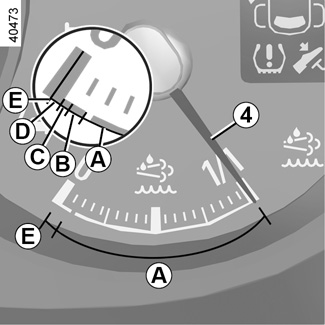
The warning light is displayed according to the level of reagent indicated by the needle 4 on the instrument panel.
Maintenance/Range
Gauge level | Warnings | What to do? |
|---|---|---|
Range A | - | - |
Range B | comes on. | You or an Approved Dealer should fill or top up the reagent tank. |
Range C | flashes for a few seconds at the start of the warning and each time the ignition is switched on, then stays on. | |
Range D | flashes for a few seconds at the start of the warning and each time the ignition is switched on, then stays on. It is accompanied by beeps. | Loss of engine power. You or an Approved Dealer should fill the reagent tank as soon as possible. |
At E | Empty tank. flashes accompanied by beeps and the message “CHECK ANTI- POLLUTION”. | In this case, at the next engine stop/start, the vehicle speed is limited to approximately 12 mph (20 km/h) until you fill the reagent tank or have it done by an Approved Dealer. |
System fault
When the indicator lights described light up, this may be accompanied by a beep.
Indicator lights | Readings |
|---|---|
and © come on. | Indicates a fault in the system. Contact your approved dealer as soon as possible. |
and © flash when the engine is started then stay lit. | Indicates a system fault with a loss of engine power. Contact your approved dealer as soon as possible. |
and © flash. | Indicates a fault in the system. In this case, at the next engine stop/start, the vehicle speed is limited to approximately 12 mph (20 km/h). Contact your approved dealer as soon as possible. |