Renault Kangoo 2 phase 2

Depending on the vehicle, they are composed of:
- seat belt pretensioners;
- driver and passenger front airbags 1.
These systems are designed to act independently or together when the vehicle is subjected to a frontal impact.
Depending on the severity of the impact, the system can trigger:
- seat belt 2 locking;
- the seat belt pretensioner (which engages to correct seat belt slack);
- the front airbag.
Pretensioners
The pretensioners hold the seat belt against the body, holding the occupant more securely against the seat, thus increasing the seat belt’s efficiency.
With the ignition on, following a significant frontal impact and depending on the severity of the impact, the system may trigger the seat belt pretensioner which instantly retracts the seat belt.
- Have the entire restraint system checked following an accident.
- No operation whatsoever is permitted on any part of the system (pretensioners, airbags, computers, wiring) and the system components must not be reused on any other vehicle, even if identical.
- Only qualified personnel from our Network may work on the airbags; otherwise the system may trigger accidentally and cause injury.
- The electric trigger system may only be tested by a specially trained technician using special equipment.
- When the vehicle is scrapped, contact an approved dealer for disposal of the pretensioner and airbags gas generators.
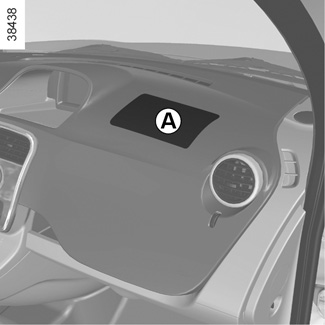
driver and passenger front Airbags
They are fitted to the front seats on the driver’s side and, depending on the vehicle, on the passenger’s side as well.
The “airbag” marking on the steering wheel, dashboard (airbag A area) and, depending on the vehicle, a symbol at the bottom of the windscreen confirm that this equipment is present.
Each airbag system consists of:
- an airbag and gas generator fitted on the steering wheel for the driver and in the dashboard for the passenger;
- an electronic unit for system monitoring which controls the gas generator electrical trigger system;
- a single indicator light å on the instrument panel;
- remote sensors.
Operation
This system is only operational when the ignition is switched on.
In a severe frontal impact, the airbags inflate rapidly, cushioning the impact of the driver's head and chest against the steering wheel and of the front passenger against the dashboard. The airbags then deflate immediately so that the passengers are not in any way hindered from leaving the vehicle.
Load limiter
Above a certain severity of impact, this mechanism is used to limit the force of the belt against the body so that it is at an acceptable level.
Vehicle fitted with three front seats
The passenger airbag airbag only protects the front side passenger; the front centre passenger is only protected by the seat belt. Please follow the usual safety instructions (wearing the seat belt).
Risk of injury in the event of an accident.
The airbag system uses pyrotechnic principles. This explains why, when the airbag inflates, it will generate heat, produce smoke (this does not mean that a fire is about to start) and make a banging noise. In a situation where an airbag is required, it will inflate immediately and this may cause some minor, superficial grazing to the skin or other reactions.

The following conditions will trigger the pretensioners or airbags.
In a frontal impact against a rigid (non-deformable) surface at an impact speed equal to or greater than 16 mph (25 km/h).

In a frontal impact with another vehicle of an equivalent or higher category, with an impact area equal to or greater than 40%, where the speed of both vehicles is equal to or greater than 25 mph (40 km/h).

In a side impact with another vehicle of an equivalent or higher category, at an impact speed equal to or greater than 31 mph (50 km/h).

In the following examples, the pretensioners or the airbags could operate:
- impact under vehicle such as pavement;
- potholes;
- drop or hard landing;
- stones;
-...
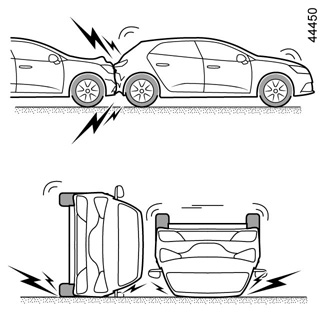
In the following examples, the pretensioners or airbags might not operate:
- rear impact, however severe;
- the vehicle overturning.

- side impact to the front or rear of the vehicle;
- frontal impact, under the tail of a lorry;
- frontal impact against an obstacle with a sharp angle;
-...
All of the warnings below are given so that the airbag is not obstructed in any way when it is inflated and also to prevent the risk of serious injuries caused by items which may be dislodged when it inflates.
Warnings concerning the driver’s airbag
- Do not modify the steering wheel or the steering wheel boss.
- Do not cover the steering wheel boss under any circumstances.
- Do not attach any objects (badge, logo, clock, telephone cradle, etc.) to the steering wheel boss.
- The steering wheel must not be removed (except by qualified personnel from our Network).
- Do not sit too close to the steering wheel when driving: sit with your arms slightly bent (see the information on “Adjusting your driving position” in the paragraph entitled “Seat belts” in Section 1). This will allow sufficient space for the airbag to deploy correctly and be fully effective.
Warnings concerning the passenger airbag
- Do not attach or glue any objects (badge, logo, clock, telephone holder, etc.) to the dashboard on or near the airbag area.
- Do not place anything between the dashboard and the passenger (animal, umbrella, walking stick, parcels, etc.).
- The passenger must not put his or her feet on the dashboard or seat as there is a risk that serious injuries may occur. As a general rule, keep all body parts (knees, hands, head, etc.) away from the dashboard.
- The devices in addition to the front passenger seat belt should be reactivated as soon as a child seat is removed, to ensure the protection of the passenger in the event of an impact.
A REAR-FACING CHILD SEAT MUST NOT BE FITTED TO THE FRONT PASSENGER SEAT UNLESS THE ADDITIONAL RESTRAINT SYSTEMS, IE. THE PASSENGER AIR BAG, ARE DEACTIVATED.
(Refer to the paragraph entitled “Child safety: deactivation, activation of the front passenger airbag” in Section 1).