Renault Kangoo 2 phase 2
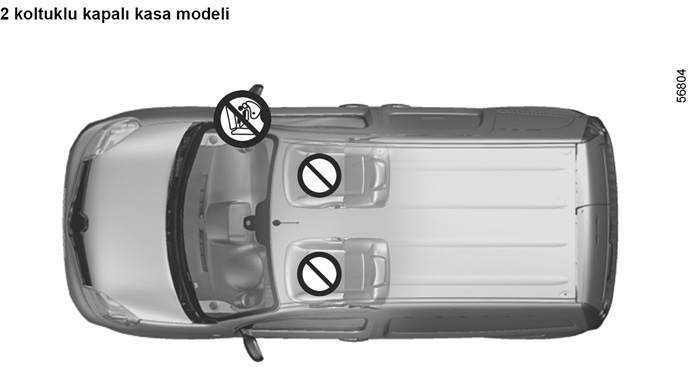
Child seat attached using the belt
¬ Seat which allows a child seat with “Universal” approval to be attached by a seat belt.
² Seat not suitable for fitting child seats.
³ Check the status of the air bag before fitting a child seat or allowing a passenger to use the seat.
Van version Type of seat group (weight of the child) | Seats suitable for fitting a child seat Front passenger seat | |
WITH PASSENGER AIRBAG (1) | WITHOUT PASSENGER AIR BAG | |
Group 0, 0+ (weight below 13 kg) | X | X |
Group I (weight from 9 kg to 18 kg) | X | X |
Groups II and III (weight from 15 kg to 36 kg) | X | X |
The van version with two front seats complies with European regulations.
(1) RISK OF DEATH OR SERIOUS INJURY: before installing a rear-facing child seat in the front passenger seat, make sure the air bag has been deactivated (refer to the “Child safety: front passenger airbag deactivation/activation” paragraph in Section 1).

Child seat attached using the belt
¬ Seat which allows a child seat with “Universal” approval to be attached by a seat belt.
² Seat not suitable for fitting child seats.
Van version Type of seat group (weight of the child) | Seats suitable for fitting a child seat Front passenger seat (1) | |
SIDE PASSENGER | CENTRE PASSENGER | |
Group 0, 0+ (weight below 13 kg) | U | X |
Group I (weight from 9 kg to 18 kg) | U | X |
Groups II and III (weight from 15 kg to 36 kg) | U | X |
The van version with three front seats complies with the local regulations in the country where the vehicle is sold.
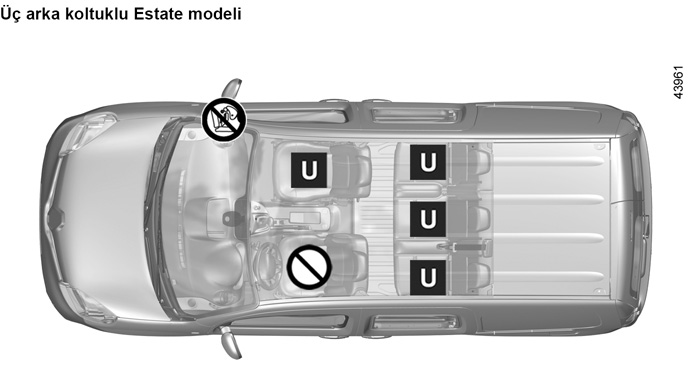
¬ Seat which allows a child seat with “Universal” approval to be attached by a seat belt.
² Seat not suitable for fitting child seats.
³ Check the status of the air bag before fitting a child seat or allowing a passenger to use the seat.
Using a child safety system which is not approved for this vehicle will not properly protect the baby or child. They risk serious or even fatal injury.
RISK OF DEATH OR SERIOUS INJURY: before installing a rear-facing child seat in the front passenger seat, make sure that the airbag has been deactivated (see the information on “Child safety: front passenger airbag deactivation/activation” in Section 1).
The Estate version with three rear seats complies with the local regulations in the country where the vehicle is sold.
The table below summarises the information already shown on the diagram on the previous page, to ensure the regulations in force are respected.
Sport tourer versions Type of child seat | Weight of the child | Front passenger seat (5) (1) | Rear side seats | Rear centre seat |
Carrycot fitted across the vehicle Group 0 | < 10 kg | X | U (2) | U (2) |
Shell seat/rear-facing seat Group 0, 0+ and 1 | < 13 kg and 9 to 18 kg | U | U (3) | U (3) |
Forward-facing seat Group 1 | 9 to 18 kg | X | U (4) | U (4) |
Booster seat Group 2 and 3 | 15 to 25 kg and 22 to 36 kg | X | U (4) | U (4) |
X = Seat not suitable for fitting child seats.
U = Seat allowing a child seat with “Universal” approval to be attached by the seat belt; check that it can be fitted.
(1) Only a rear-facing child seat can be fitted in this seat: position the vehicle seat as far back and raise it as much as possible, and tilt the seatback slightly (approximately 25°).
(2) A carrycot is fitted crosswise and occupies at least two seats (the child’s feet are placed nearest the door).
(3) In order to install a rear-facing child seat, move the front seat as far forward as possible, then move the front seat back as far as it will go, without allowing it to come into contact with the child seat.
(4) Forward-facing child seat; position the seatback of the child seat in contact with the seatback of the vehicle seat. Adjust the headrest, or remove it if necessary. In addition, do not push the seat in front of the child further than halfway along its runners, or incline the seatback more than 25°.
(5) RISK OF DEATH OR SERIOUS INJURY: before installing a rear-facing child seat in the front passenger seat, make sure the air bag has been deactivated (refer to the information on “Child safety: front passenger air bag deactivation/activation” in Section 1).