Renault Trafic
5-seater Combi version
Fitting diagram

-

Seat which does not allow a child seat to be fitted.
Child seat attached using the mounting Isofix
 Seat which allows an Isofix child seat to be fitted.
 The rear seats are fitted with an anchorage point which allows a forward-facing ISOFIX child seat with universal approval to be attached. The anchorage points are located in the luggage compartment and are visible.
The size of the ISOFIX child seat is indicated by a letter:
- F3 [A], F2 [B], F2X [B1]: for forward-facing seats in Group 1 (9 to 18 kg);
- R3 [C]: rear-facing seats in Group 1 (9 to 18 kg);
- R2 [D], R1 [E]: rear-facing seats or shell seats in Group 0 or 0+ (less than 13 kg);
- L1 [F], L2 [G]: carrycots in Group 0 (less than 10 kg);
- B2, B3: boosters in groups 2 and 3 (15 to 25 kg and 22 to 36 kg).
warning
Using a child safety system which is not approved for this vehicle will not properly protect the baby or child. They risk serious or even fatal injury.
warning
Check that your child is always strapped in and that the belt or safety harness used is correctly set and adjusted Rear seat belts.
If necessary, adjust the seat position accordingly.
5-seater Combi version: installation table
The table below summarises the information already shown on the previous diagram in order to ensure the regulations in force are respected.
5-seater Combi version | |||||
|---|---|---|---|---|---|
Type of child seat | Weight of the child | Seat sizeISOFIX [Height] | Front passenger seat | Rear side seat | Rear centre seat |
Carrycot fitted across the vehicle Group 0 | < 10 kg | L1 [F], L2 [G] | X | IL (1) | X |
Rear-facing shell seat Groups 0 and 0+ | < 13 kg | R1 [E] | X | IL (2) | X |
Rear-facing seat Groups 0+ and 1 | < to 13 kg and 9 to 18 kg | R3 [C], R2 [D] | X | IL (2) | X |
Forward-facing seat Group 1 | 9 to 18 kg | F3 [A], F2 [B], F2X [B1] | X | IUF-IL (3) | X |
Booster seat Groups 2 and 3 | 15 to 25 kg and 22 to 36 kg | B2 | X | IUF-IL (3) | X |
B3 | X | IUF-IL (3) | X | ||
I-Size seat | Rear-facing seat | X | X | X | |
Forward-facing seat | X | X | X | ||
Booster seat | X | X | X | ||
X = Seat which does not allow a child seat Isofix to be fitted.
IUF/IL = Seat enabling a child seat with "Universal/Semi-universal or vehicle-specific" approval to be attached by Isofix (on equipped vehicles): check that it can be fitted.
(1) A carrycot can be installed across the vehicle and will take up at least two seats. Position the child with his or her feet nearest the door.
(2) In order to install a rear-facing child seat, move the front seat as far forward as possible, then move the front seat back as far as it will go, without allowing it to come into contact with the child seat.
(3) To fit a forward-facing child seat, position the back of the child seat in contact with the vehicle seatback. In all situations, remove the rear headrest of the seat on which the child seat is positioned. This action must be performed before fitting the child seat Rear headrests. Do not push the seat in front of the child more than halfway back on its runners and do not recline the seatback more than 25°.
6-seater Combi version

-
Seat which does not allow a child seat to be fitted.
Child seat attached using the mounting Isofix
Seat which allows an Isofix child seat to be fitted.
The rear seats are fitted with an anchorage point which allows a front-facing Isofix child seat with universal approval to be attached. The anchorage points are located in the luggage compartment and are visible.
The size of the Isofix child seat is indicated by a letter:
- F3 [A], F2 [B], F2X [B1]: for forward-facing seats in Group 1 (9 to 18 kg);
- R3 [C]: rear-facing seats in Group 1 (9 to 18 kg);
- R2 [D], R1 [E]: rear-facing seats or shell seats in Group 0 or 0+ (less than 13 kg);
- L1 [F], L2 [G]: carrycots in Group 0 (less than 10 kg);
- B2, B3: boosters in groups 2 and 3 (15 to 25 kg and 22 to 36 kg).
warning
Using a child safety system which is not approved for this vehicle will not properly protect the baby or child. They risk serious or even fatal injury.
warning
Check that your child is always strapped in and that the belt or safety harness used is correctly set and adjusted Rear side seat belts.
If necessary, adjust the seat position accordingly.
6-seater Combi version: installation table
The table below summarises the information already shown on the previous diagram in order to ensure the regulations in force are respected.
6-seater Combi version | ||||||
|---|---|---|---|---|---|---|
Type of child seat | Weight of the child | Seat sizeIsofix [Height] | Front seat | Rear seat | ||
Central passenger | Side passenger | Side | Central | |||
Carrycot fitted across the vehicle Group 0 | < 10 kg | L1 [F], L2 [G] | X | X | X | X |
Rear-facing shell seat Groups 0 and 0+ | < 13 kg | R1 [E] | X | X | IL (2) | X |
Rear-facing seat Groups 0+ and 1 | < to 13 kg and 9 to 18 kg | R3 [C], R2 [D] | X | X | X | X |
Forward-facing seat Group 1 | 9 to 18 kg | F3 [A], F2 [B], F2X [B1] | X | X | IUF-IL (3) | X |
Booster seat Groups 2 and 3 | 15 to 25 kg 22 to 36 kg | B2 | X | X | IUF-IL (3) | X |
B3 | X | X | IUF-IL (3) | X | ||
I-Size seat | Rear-facing seat | X | X | X | X | |
Rear-facing seat | X | X | X | X | ||
Booster seat | X | X | X | X | ||
X = Seat which does not allow a child seat Isofix to be fitted.
IUF/IL = Seat enabling a child seat with "Universal/Semi-universal or vehicle-specific" approval to be attached by Isofix (on equipped vehicles): check that it can be fitted.
(1) A carrycot can be installed across the vehicle and will take up at least two seats. Position the child with his or her feet nearest the door.
(2) In order to install a rear-facing child seat, move the front seat as far forward as possible, then move the front seat back as far as it will go, without allowing it to come into contact with the child seat.
(3) To fit a forward-facing child seat, position the back of the child seat in contact with the vehicle seatback. In all situations, remove the rear headrest of the seat on which the child seat is positioned. This action must be performed before fitting the child seat Rear headrests. Do not push the seat in front of the child more than halfway back on its runners and do not recline the seatback more than 25°.
8-seater Bus/Combi version
Fitting diagram

-
Seat which does not allow a child seat to be fitted.
Child seat attached using the mounting Isofix
Seat which allows an ISOFIX child seat to be fitted.
The rear seats are fitted with an anchorage point which allows a front-facing Isofix child seat with universal approval to be attached. The anchorage points are located in the luggage compartment and are visible.
The size of the Isofix child seat is indicated by a letter:
- F3 [A], F2 [B], F2X [B1]: for forward-facing seats in Group 1 (9 to 18 kg);
- R3 [C]: rear-facing seats in Group 1 (9 to 18 kg);
- R2 [D], R1 [E]: rear-facing seats or shell seats in Group 0 or 0+ (less than 13 kg);
- L1 [F], L2 [G]: carrycots in Group 0 (less than 10 kg);
- B2, B3: boosters in groups 2 and 3 (15 to 25 kg and 22 to 36 kg).
warning
Using a child safety system which is not approved for this vehicle will not properly protect the baby or child. They risk serious or even fatal injury.
warning
Check that your child is always strapped in and that the belt or safety harness used is correctly set and adjusted Rear side seat belts.
If necessary, adjust the seat position accordingly.
8-seater Combi/Bus version: installation table
The table below summarises the information already shown on the previous diagram in order to ensure the regulations in force are respected.
8-seater Bus/Combi version | |||||||
|---|---|---|---|---|---|---|---|
Type of child seat | Weight of the child | Seat sizeIsofix [Height] | Front passenger seat | Rear seat | |||
2nd row side seats | 2nd row centre seat | 3rd row side seats | 3rd row centre seat | ||||
Carrycot fitted across the vehicle Group 0 | < 10 kg | L1 [F], L2 [G] | X | IL (1) | X | X | X |
Rear-facing shell seat Groups 0 and 0+ | < 13 kg | R1 [E] | X | IL (2) | X | X | X |
Rear-facing seat Groups 0+ and 1 | < to 13 kg and 9 to 18 kg | R3 [C], R2 [D] | X | IL (2) | X | X | X |
Forward-facing seat Group 1 | 9 to 18 kg | F3 [A], F2 [B], F2X [B1] | X | IUF-IL (3) | X | X | X |
Booster seat Groups 2 and 3 | 15 to 25 kg 22 to 36 kg | B2 | X | IUF-IL (3) | X | X | X |
B3 | X | IUF-IL (3) | X | X | X | ||
I-Size seat | Rear-facing seat | X | X | X | X | X | |
Forward-facing seat | X | X | X | X | X | ||
Booster seat | X | X | X | X | X | ||
X = Seat which does not allow a child seat Isofix to be fitted.
IUF/IL = Seat enabling a child seat with "Universal/Semi-universal or vehicle-specific" approval to be attached by Isofix (on equipped vehicles): check that it can be fitted.
(1) A carrycot can be installed across the vehicle and will take up at least two seats. Position the child with his or her feet nearest the door.
(2) In order to install a rear-facing child seat, move the front seat as far forward as possible, then move the front seat back as far as it will go, without allowing it to come into contact with the child seat.
(3) To fit a forward-facing child seat, position the back of the child seat in contact with the vehicle seatback. In all situations, remove the rear headrest of the seat on which the child seat is positioned. This action must be performed before fitting the child seat Rear headrests. Do not push the seat in front of the child more than halfway back on its runners and do not recline the seatback more than 25°.
9-seater Bus/Combi version
Fitting diagram
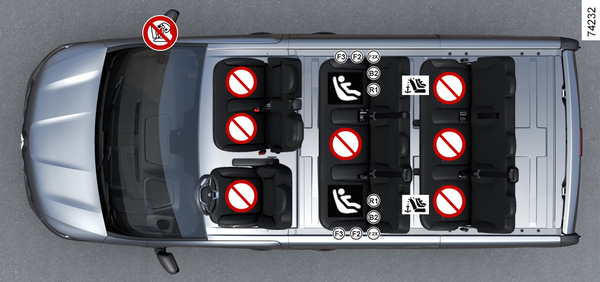
-
Seat which does not allow a child seat to be fitted.
Child seat attached using the ISOFIX system
Seat which allows an ISOFIX child seat to be fitted.
The rear seats are fitted with an anchorage point which allows a front-facing Isofix child seat with universal approval to be attached. The anchorage points are located in the luggage compartment and are visible.
The size of the Isofix child seat is indicated by a letter:
- F3 [A], F2 [B], F2X [B1]: for forward-facing seats in Group 1 (9 to 18 kg);
- R3 [C]: rear-facing seats in Group 1 (9 to 18 kg);
- R2 [D], R1 [E]: rear-facing seats or shell seats in Group 0 or 0+ (less than 13 kg);
- L1 [F], L2 [G]: carrycots in Group 0 (less than 10 kg);
- B2, B3 : boosters in groups 2 and 3 (15 to 25 kg and 22 to 36 kg).
warning
Using a child safety system which is not approved for this vehicle will not properly protect the baby or child. They risk serious or even fatal injury.
warning
Check that your child is always strapped in and that the belt or safety harness used is correctly set and adjusted Rear side seat belts.
If necessary, adjust the seat position accordingly.
9-seater Combi/Bus version: installation table
The table below summarises the information already shown on the previous diagram in order to ensure the regulations in force are respected.
9-seater Bus/Combi version | ||||||||
|---|---|---|---|---|---|---|---|---|
Type of child seat | Weight of the child | Seat sizeISOFIX [Height] | Front seat | Rear seat | ||||
Central passenger | Side passenger | 2nd row side seats | 2nd row centre seat | 3rd row side seats | 3rd row centre seat | |||
Carrycot fitted across the vehicle Group 0 | < 10 kg | L1 [F], L2 [G] | X | X | X | X | X | X |
Rear-facing shell seat Groups 0 and 0+ | < 13 kg | R1 [E] | X | X | IL (2) | X | X | X |
Rear-facing seat Groups 0+ and 1 | < to 13 kg and 9 to 18 kg | R3 [C], R2 [D] | X | X | X | X | X | X |
Forward-facing seat Group 1 | 9 to 18 kg | F3 [A], F2 [B], F2X [B1] | X | X | IUF-IL (3) | X | X | X |
Booster seat Groups 2 and 3 | 15 to 25 kg 22 to 36 kg | B2 | X | X | IUF-IL (3) | X | X | X |
B3 | X | X | IUF-IL (3) | X | X | X | ||
I-Size seat | Rear-facing seat | X | X | X | X | X | X | |
Forward-facing seat | X | X | X | X | X | X | ||
Booster seat | X | X | X | X | X | X | ||
X = Seat not suitable for fitting a child seat Isofix.
IUF/IL = Seat enabling a child seat with "Universal/Semi-universal or vehicle-specific" approval to be attached by Isofix (on equipped vehicles): check that it can be fitted.
(1) A carrycot can be installed across the vehicle and will take up at least two seats. Position the child with his or her feet nearest the door.
(2) In order to install a rear-facing child seat, move the front seat as far forward as possible, then move the front seat back as far as it will go, without allowing it to come into contact with the child seat.
(3) To fit a forward-facing child seat, position the back of the child seat in contact with the vehicle seatback. In all situations, remove the rear headrest of the seat on which the child seat is positioned. This action must be performed before fitting the child seat Rear headrests. Do not push the seat in front of the child more than halfway back on its runners and do not recline the seatback more than 25°.