Renault Master 3 phase 1


Transporting objects in the rear load area
Depending on the vehicle, securing rings 1 and 2 can be used to stop transported objects from moving. The number of rings and their position may vary depending on the vehicle.
The sole purpose of rings 2 is to prevent transported objects from moving. The objects must be secured to mounting rings 1 on the vehicle floor beforehand.

F max: 625 daN
Always position the heaviest items directly on the floor. Use the lashing points on the floor of the luggage compartment, if these are fitted to the vehicle. The luggage should be loaded in such a way that no items will be thrown forward and strike the occupants if the driver has to brake suddenly. Fasten the rear seat belts, even if the seats are not occupied.
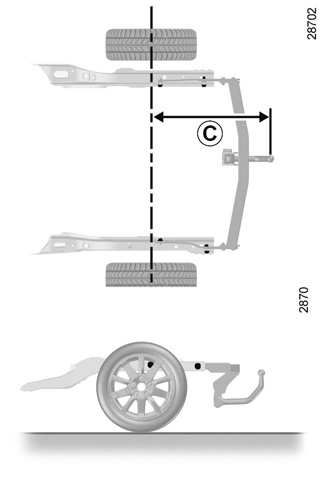
Front-wheel drive, standard wheels
C = 1,110 mm.
Rear-wheel drive, standard wheels
C = 1,760 mm.
Rear-wheel drive, dual wheels
C = 1,753 mm.
|

Towing
Fitting the towing ball
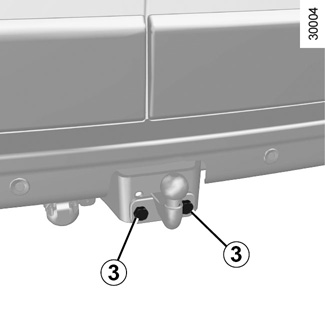
Position the ball within the range of height D, which must be between 350 and 420 mm, with the vehicle laden. Tighten bolts 3, observing a tightening torque of 196 Nm (Newton metres).
Permissible nose weight, maximum permissible towing weight, braked and unbraked: refer to the information on “Weights” in Section 6.
Choice and fitting of towing equipment
Maximum weight of towing equipment: 26 kg
For fitting and conditions of use, refer to the equipment’s fitting instructions.
Please keep these instructions with the rest of the vehicle documentation.
If the towbar ball obscures the registration plate or the rear fog lights, it should be removed when not in use.
In all cases, comply with local legislation.