Renault Scenic 4

Fuse box
If any electrical component does not work, check the condition of the fuses.
Open flap A. Press the bottom of clip 1 and pull simultaneously on flap A to remove it and access the fuses.
Use the fuse allocation label in storage compartment A to identify the fuses.
Certain fuses should only be replaced by a qualified professional. These fuses are not listed on the label.
Only change the fuses represented on the label.
In accordance with local legislation or as a precautionary measure:
obtain an emergency kit containing a set of spare bulbs and fuses from an approved Dealer.
Check the fuse in question and replace it, if necessary, by a fuse of the same rating.
If a fuse is fitted where the rating is too high, it may cause the electrical circuit to overheat (risk of fire) in the event of an item of equipment using an excessive amount of current.
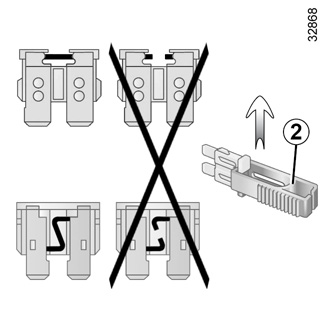
Tweezers 2
Remove the fuse using tweezers 2, located underneath the fuses.
To remove the fuse from the tweezers, slide the fuse to the side.
It is not advisable to use the free fuse locations.
Allocation of fuses
(the presence of certain fuses depends on the vehicle equipment level)
Symbol | Allocation | Symbol | Allocation | ||
|---|---|---|---|---|---|
H
| Windscreen washer
| | Not used | ||
ë
| Third row accessories socket, boot accessories socket
| O | Locking the doors and luggage compartment
| ||
Æ
| Front cigarette lighter, front and rear second row accessories socket
| Ý
| Towbar socket
| ||
| Not used |
| Diagnostic socket, audio alarm
| ||
| Heated door mirrors
| Ì
| Horn
| ||
×
| Brake lights, passenger compartment central unit
|
| Instrument panel, dashboard control lighting
| ||
| Parking brake
|
| Rear electric windows
| ||
| Additional servo | f
| Front windscreen wiper
| ||
î
| Radio, multimedia screen, multimedia accessories sockets, parking brake control
| D
| Direction indicator lights, hazard warning lights
| ||
| Passenger compartment centre unit, rear wiper, rear fog light
|
| Rear USB sockets on console
|