Renault Boreal
Depending on the vehicle, they may comprise:
- front seat belt inertia reel pretensioners;
- chest force limiters;
- airbags driver and passenger front.
These systems are designed to act independently or together when the vehicle is subjected to a frontal impact.
Depending on the severity of the impact, the system can cause:
- blocking of the seat belt;
- the seat belt pretensioner to hold the occupant in the seat, in addition to the force limiter;
- the front airbag.
Pretensioners

The pretensioners hold the seat belt against the body, holding the occupant more securely against the seat, thus increasing the seat belt's efficiency.
With the ignition on, following a significant frontal impact and depending on the severity of the impact, the system may trigger the seat belt inertia reel pretensioner 1 which instantly retracts the seat belt.
Load limiter
Above a certain level of impact force, this mechanism is used to limit the force of the belt against the body so that it is at an acceptable level.
warning
- Have the entire restraint system checked following an accident.
- No operation whatsoever is permitted on any part of the system (pretensioners, airbags, computers, wiring) and the system components must not be reused on any other vehicle, even if identical.
- Only qualified personnel from our Network may work on the airbags; otherwise the system may trigger accidentally and cause injury.
- The electrical trigger system may only be tested by a specially trained technician using special equipment.
- When the vehicle is scrapped, contact an approved dealer for disposal of the pretensioner and airbags gas generators.
Airbags driver and front passenger
They are provided for the driver's and front passenger's seats (location A).
A "Airbag" mark on the steering wheel, in the instrument panel area (area airbagA) and, depending on the vehicle, a label on the underside of the windscreen offer a reminder that this equipment is present.
Each airbag system consists of:
- a airbag and gas generator fitted on the steering wheel (for the driver) and in the dashboard (for the front passenger);
- an electronic unit that monitors the airbag gas generator electrical trigger system
- a single warning light
 on the instrument panel;
 - remote sensors (depending on the vehicle).

warning
The airbag system is based on pyrotechnic principles. This explains why when the airbag inflates, it generates heat, produces smoke (this doesn't mean a fire is about to start) and makes noise. In a situation where airbag is necessary, it will inflate immediately and this can cause small superficial scratches on the skin or other problems.

Operation
This system is only operational when the ignition is switched on.
In the event of a severe frontal impact , the airbag(s) is/are triggered quickly, cushioning the impact of the driver's head and chest against the steering wheel and the front passenger against the dashboard. The airbags then deflate immediately so that the passengers are not in any way prevented from leaving the vehicle.
Operating faults
This warning light comes on when the engine is started and then goes out after approximately three seconds.
If it does not come on when the ignition is switched on or if it stays on, there is a fault in the system.
Contact your approved Dealer as soon as possible;
Your protection will be reduced until this fault is rectified.

The following cases trigger the pretensioners or the airbags :
In a frontal impact against a rigid (non-deformable) surface at an impact speed equal to or greater than 16 mph (25 km/h) km/h.

In a frontal impact with another vehicle of an equivalent or higher category, with an impact area equal to or greater than 40%, where the speed of both vehicles is equal to or greater than 25 mph (40 km/h) km/h.

In a side impact with another vehicle of an equivalent or higher category, at an impact speed equal to or greater than 31 mph (50 km/h) km/h.

In the following examples, the pretensioners or airbags may be triggered:
- impacts to the underside of the vehicle, from kerbs;
- potholes;
- a fall or a hard landing;
- stones;
- ...
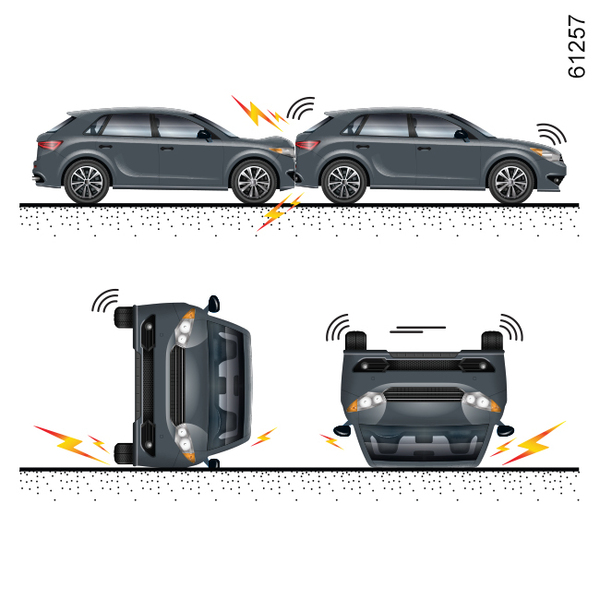
The pretensioners or airbags may not be triggered by:
- a rear impact, however severe;
- the vehicle overturning;

- side impact at the front or rear of the vehicle;
- frontal impact, underneath the tail of a lorry;
- frontal impact against an obstacle with a sharp angle;
- ...
Warnings
All of the warnings below are given so that the airbag airbag is not obstructed in any way when it is inflated and also to prevent serious injuries when it inflates.
warning
Warnings regarding the driver's airbag
- Do not modify the steering wheel or its airbag system.
- Never cover the steering wheel airbag system.
- Never attach any object (such as a clip, badge, watch, mobile phone holder, etc.), to the steering wheel boss.
- The steering wheel must not be removed (except by qualified personnel at an Approved Dealership).
- Do not sit too close to the steering wheel: sit with your arms slightly bent Seat belts. This will allow sufficient space for the airbag to inflate properly.
Warnings regarding the passenger airbag
- Do not attach or affix any objects (badge, logo, watch, mobile phone holder, etc.) on the dashboard, over or near the airbag.
- Do not place anything between the dashboard and the passenger (pet, hat, umbrella, fishing rod, parcels, etc.).
- The passenger must not put his or her feet on the dashboard or seat as there is a risk that serious injuries may be sustained. As a general rule, keep all parts of your body (knees, hands, head, etc.) away from the dashboard.
- Reactivate the passenger airbag as soon as you remove the child seat, to ensure the protection of the front passenger in the event of an impact.
A CHILD SEAT MUST NOT BE INSTALLED ON THE FRONT PASSENGER SEAT UNLESS ADDITIONAL ATTACHMENT SYSTEMS ARE DEACTIVATED .