Renault Boreal
Fuel consumption is approved in accordance with standard and regulatory procedures.
They are identical for all manufacturers and allow vehicles to be compared with each other.
Real consumption depends on vehicle usage conditions, the equipment fitted and the user’s driving style.
To optimise fuel consumption, please refer to the following advice.
Depending on the vehicle, there are a variety of functions available to help you reduce fuel or energy consumption:
- the rev counter;
- Gear change indicator:
- driving style indicator
- journey record and eco-driving recommendations displayed on the multimedia screen;
- Acceleration indicator Eco;
- ECO mode;
- Stop and StartStop and Start function function.
If installed on your vehicle, the navigation system gives you more information.
On instrument panel A or B
Depending on the vehicle, the information display can be arranged and customised based on the instrument panel customisation style selected on the multimedia screen.
Gear change indicator 1

Depending on the vehicle, to obtain optimum consumption levels, a warning light on the instrument panel lets you know the best time to move up or down a gear:
 shift up a gear;
 to downshift one gear.
If you make a habit of following the indicator, the vehicle's fuel consumption will be reduced.
Driving style indicator 2

Once activated, it provides real-time information on your driving style. You will be notified by indicator 2.
The more the petals displayed on indicator 2, the more flexible and economical is your driving style.
If you make a habit of monitoring the indicator, the vehicle's fuel consumption will be reduced.
See the multimedia instructions for more information.
Acceleration indicator Eco3
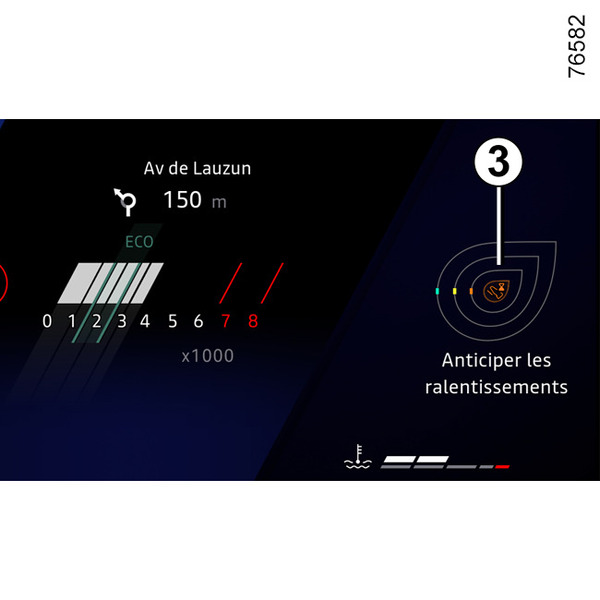
Depending on the vehicle, it informs you in real time on whether you are accelerating moderately or intensely.
You will be notified by indicator 3:
- green: acceleration is moderate and correct;
- white: acceleration is very high;
- grey: acceleration is high.
Note: it is not possible to display the driving style indicator 2 and the acceleration indicator Eco3 at the same time.
On the multimedia screen
Trip report

When the engine is switched off, the "Trip Report" appears on the multimedia screen 4, allowing you to see information about your last trip.
This displays:
- the overall score;
- score progress;
- the distance without fuel consumption.
A score of 0 to 100 is shown so that you can assess your eco driving performance.
The higher the score, the better the fuel consumption.
The idea of the eco score is to help you improve your performance.
With your favourite routes saved, you can compare the performance between trips and the performance of other drivers.
See the multimedia instructions for more information.
ECO mode
ECO mode is a function which optimises fuel consumption.
It affects certain driving operations (acceleration, gear shifting, cruise control, deceleration, etc.)
The acceleration limiter reduces fuel consumption in urban and similar areas.

Activating the function
Depending on the vehicle, the function can be enabled:
- by pressing switch 5;
- on the multimedia screen (see multimedia instructions).
The
 indicator light lights up on the instrument panel to confirm activation.
While driving, it is possible to leave the ECO mode temporarily in order to improve engine performance.
To do this, press the accelerator pedal firmly and fully.
ECO mode is reactivated when you take pressure off the accelerator pedal.
Disabling the feature
Depending on the vehicle, the function can be disabled:
- by pressing switch 5;
The
indicator light disappears from the instrument panel to confirm deactivation.
Driving advice, ECO-driving

Behaviour
- Drive carefully until the engine reaches its normal operating temperature, rather than letting it heat up while the vehicle is stationary.
- Speed is expensive.
- Driving dynamically – accelerating and braking frequently – is costly in terms of the fuel consumed versus the time saved.
- Do not accelerate excessively with the engine in intermediate gears.
You should always use the highest gear possible.
- Avoid sudden acceleration.
- Brake as little as possible. If you anticipate an obstacle or bend in advance, you may then simply release the accelerator pedal.
- Do not try to maintain the same speed up a hill, accelerate no more than you would on flat terrain. It is preferable to keep your foot in the same position on the accelerator pedal.
- Double declutching and accelerating before switching off the engine are unnecessary in modern vehicles.
- Bad weather, flooded roads:
| Do not drive through floods if the water is above the lower edge of the wheel rims. |

warning
Obstructions to driving
On the driver's side, only use mats suitable for the vehicle, attached with the pre-fitted components, and check the fitting regularly. Do not lay several mats on top of each other.
There is a risk of wedging the pedals.

Tyres
- An under-inflated tyre increases fuel consumption.
- To optimise fuel consumption, set the tyre pressure according to the highest speed or to the recommended pressure indicated on the edge of the driver's door.
- The use of non-recommended tyres can increase fuel consumption.

Advice on use
- Give preference to using ECO mode.
- Electricity is petrol. Therefore, switch off all electrical components when they are not genuinely needed. However (safety first), keep your lights on when visibility is bad (“see and be seen”).
- Use the air vents. Driving with the windows open at 62 mph (100 km/h) will increase fuel consumption by as much as 4%.
- Never fill the fuel tank to the brim to avoid overflow.
- On vehicles equipped with air conditioning, it is normal to observe an increase in fuel consumption when it is used (especially in urban driving conditions). Switch off the air conditioning when it is not required on vehicles fitted with manual air conditioning.
Suggestions for reducing fuel consumption and therefore helping to protect the environment:
If the vehicle has been parked in the sun, open the doors for a few moments to let the hot air escape before starting the engine.
- Do not leave an empty roof rack fitted to the vehicle.
- It is better to transport bulky objects in a trailer.
- When towing a caravan, fit a wind deflector and adjust it carefully.
- Avoid using the vehicle for door-to-door calls (short journeys with long waits in between) because the engine never reaches its ideal operating temperature.
Climate control
It is normal to notice an increase in fuel consumption of the vehicle when using the heating (particularly in sub-zero outside temperatures) or air conditioning.