Renault Clio
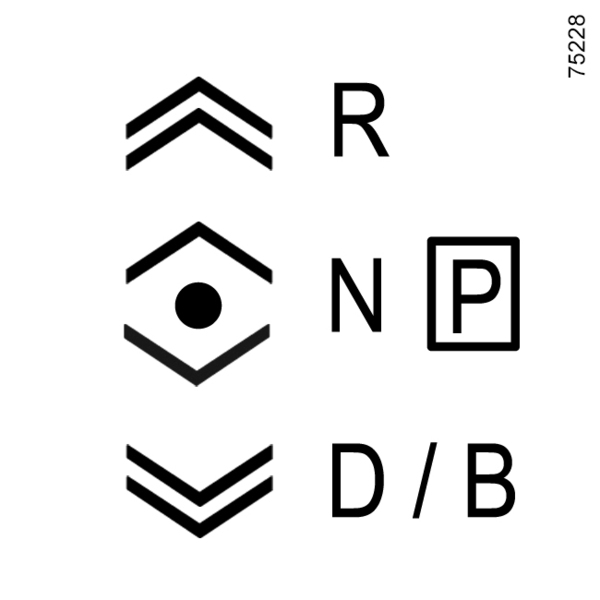
Electronic selector lever 1

R: reverse gear
N: neutral
D: forward gear
B: forward gear with increased regenerative braking (depending on the vehicle)
P: park, button 2
The gear engaged is displayed on the instrument panel.
One-touch selector

Move the selector lever 1 one or two notches forwards or backwards to engage the desired position (R, N, D or, depending on the vehicle, B) then release the lever and it will return to its stable position.
The position engaged lights up on the instrument panel.
If certain conditions prevent shifting from one position to another, the current position flashes on the instrument panel.
To engage P position

With the vehicle stationary and the engine running or the ignition on, press the button 2 to engage P position.
To disengage position P
With the vehicle stationary and the engine on, press the brake pedal and move the selector lever 1 upwards or downwards according to the position desired.
If the brake pedal is not fully pressed, the "Press brake pedal" message and
 warning light are displayed on the instrument panel.
To engage Neutral ( N position)
With the vehicle stationary and the engine on, to engage N, position, it is necessary to press the brake pedal before moving the selector lever 1 one notch upwards or downwards.
warning
Check that the P warning light on the instrument panel is activated before leaving the vehicle.
Risk of loss of immobilisation of the vehicle
To engage forward gear ( D position)
With the vehicle stationary, the engine running and your foot on the brake pedal, move the selector lever 1 two notches downwards to engage D position.
The gears will change automatically at the right time and at the most suitable engine speed as the automatic system takes into account the vehicle load and road contour and adjusts itself to the particular driving style you have chosen.
Note: with the engine running and the vehicle travelling at between 0 and 5 mph (0 and 8 km/h), in N or R position, you will have to press the brake pedal in order to engage D position.
Economical driving
When driving, always leave the lever in position D, keeping the accelerator pedal lightly depressed to ensure automatic gear changes at a lower engine speed.
Accelerating and overtaking
Depress the accelerator pedal briskly and fully (so that it goes beyond the kickdown point).
It is also possible to shift down at any time for overtaking purposes, by pressing the left-hand paddle.
To engage reverse gear ( R position)
With the vehicle stationary and the engine on, move the selector lever 1 two notches upwards to engage R position.
If the brake pedal is not pressed, a beep will sound, the R position display will flash for around five seconds on the grid shown on the instrument panel and the "Press brake pedal" message will be displayed for around five seconds.
Note: with the engine running and the vehicle travelling at between 0 and 5 mph (0 and 8 km/h), in N or D position, you will have to press the brake pedal in order to engage R position.
Driving in mode B
(depending on the vehicle)
This mode allows driving with a more dynamic regenerative mode. By releasing the accelerator, the vehicle uses regenerative braking to slow down the vehicle. Thus the motor generates higher electrical current which allows the traction battery to be recharged.
Note: with D, R or B position engaged (depending on the vehicle), if the vehicle is stationary it will move forward as soon as you release the brake pedal (without pressing on the accelerator pedal).
In B mode, the regenerative braking performance will be reduced if the battery is cold or fully charged.
Move from D position to B or B to D
(depending on the vehicle)
To switch from one position to the other, tilt the lever to one notch or two notches backwards.
The selected gear lever position is displayed on the instrument panel.
Gear change paddles 3 and 4

Depending on the vehicle, the gear change paddles 3 and 4 can be used to change gear when the lever is in D position.
3: shift down a gear (˗).
4: shift up a gear (+).
The P, N and R positions cannot be accessed using the paddles.
Driving in manual mode
(vehicles equipped with gear shift paddles)
When driving in D position, you can switch to manual driving mode using paddle 3 or 4 on the steering wheel. Depending on the vehicle, two manual driving modes are available:
- the "temporary" manual mode can be used to force gear shifting by briefly pressing one of the two paddles. The driving mode D and the gear engaged appear on the instrument panel.
Note: the gearbox automatically returns to automatic mode D if the gear engaged is no longer optimal to vehicle performance or if no action has been taken on a paddle for a certain amount of time.
- permanent manual mode is activated by pressing and holding either of the paddles. The driving mode M and the engaged gear will appear on the display 5 on the instrument panel.

Note: depending on the vehicle, the return to automatic mode is carried out by pressing and holding the right-hand paddle or by moving the one-touch lever 1 one or two notches downwards.
In all situations:
- to shift down through the gears, press the left-hand paddle;
- to move up through the gears, press the right-hand paddle.
Note: the + and ˗ indicators advise the driver to shift up or down a gear.
Special cases
In certain driving conditions (resulting in, for example, engine protection, activation of the electronic stability control (ESC), etc.), the automatic system may change the gear automatically.
Likewise, to prevent incorrect manoeuvres, a gear change may be refused by the automatic system: in this case the gear display flashes for a few seconds as a warning.
Special circumstances
- If the road type or weather conditions (steep uphill slopes, sudden downhill slopes, deep snow, sand or mud) make it difficult to stay in automatic mode. On vehicles equipped with gear shift paddles, it is advisable to change to manual mode using the paddles. This will prevent the automatic gearbox from changing gears repeatedly when driving uphill, and permit engine braking on long descents.
- In cold weather, to avoid stalling start the engine and wait a few seconds before disengaging P or N position and shifting the lever to D or R position.
Parking the vehicle
P position is engaged automatically along with the electronic parking brake (if the vehicle is equipped), when:
- the engine is stopped;
- the driver's seatbelt is unfastened and the vehicle is stopped;
and
- the driver's door is opened and the vehicle is stopped.
P is displayed on the instrument panel.
As P position is automatically engaged when the engine is stopped, you may have to engage N position in some situations, for example in some car washes:
- with the engine running, press the P button, shift the selector lever 1 a notch upwards or downwards then switch off the engine.
- with the engine off and the ignition on, shift the selector lever 1 one notch upwards or downwards.
The next time the engine is restarted, P position is engaged automatically according to the cases described earlier.
tip
The P position must only be engaged when the vehicle is stationary.
tip
When facing uphill, to remain stopped, do not keep your foot on the accelerator.
Risk of overheating the automatic gearbox.
warning
For safety reasons, do not switch off the ignition before the vehicle has come to a complete standstill.
Maintenance period
Refer to the maintenance document for your vehicle or consult an approved Dealer to check whether the automatic gearbox requires scheduled maintenance.
If it does not need to be serviced, there is no need to top up the oil.
Operating faults
- during driving, if the "WARNING: Check Gearbox" message appears on the instrument panel, this indicates a fault.
Contact an approved dealer as soon as possible;
- during driving, if the "WARNING: Gearbox Overheating" or "Gearbox Hot: Temporarily Stop" messages appear on the instrument panel, stop the vehicle as soon as possible to enable the gearbox to cool and until the message disappears;
- during driving, if the "WARNING: Gearbox Failure Risk" message appears on the instrument panel, the engine performance is deliberately limited in order to maintain the gearbox.
Contact an approved dealer as soon as possible;
- breakdown recovery of a vehicle with an automatic gearbox Towing: breakdown.
warning
An impact to the underside of the vehicle while manoeuvring (e.g. striking a post, raised kerb or other street furniture) may result in damage to the vehicle (e.g. deformation of an axle).
To avoid any risk of accident, have your vehicle checked by an approved Dealer.
In the event of engine failure or an electrical fault (battery fault) affecting operation of the automatic gearbox, ensure that the vehicle is properly immobilised.
If the "Auto gearbox P failure" message appears on the instrument panel, P position cannot be engaged. Be sure to secure the vehicle with the electronic parking brake and consult an approved dealer.